 blog
Top 5 Commercial Garage Door Openers for Warehouses
Table of Contents
- Quick Comparison: Top 5 Commercial Garage Door Openers for Warehouses
- How We Evaluated These Commercial Garage Door Openers
- 1. Trolley Operators: Best for Standard Warehouse Doors
- 2. Jackshaft Operators: Best for High-Cycle Loading Dock Doors
- 3. Hoist Operators: Best for Oversized Industrial Doors
- 4. High-Speed DC Operators: Best for Maximum Throughput
- 5. Smart-Connected Operators: Best for Remote Monitoring
- Commercial Garage Door Opener Installation Cost: What Affects Your Quote
- Frequently Asked Questions
Last Updated: September 16, 2026
Quick Comparison: Top 5 Commercial Garage Door Openers for Warehouses
Choosing among the top 5 commercial garage door openers for warehouses comes down to matching the operator type to your door's weight, cycle rate, and mounting space. Trolley, jackshaft, hoist, high-speed DC, and smart-connected operators each solve a different problem, and picking wrong means premature wear or a door that can't keep up with dock traffic.
| Operator Type | Mounting | Best For | Duty Cycle |
|---|---|---|---|
| Trolley | Ceiling rail | Standard warehouse doors | Standard to heavy-duty |
| Jackshaft | Side-mounted on shaft | High-cycle dock doors | High-cycle continuous |
| Hoist | Wall or floor mount | Oversized industrial doors | Heavy-duty |
| High-speed DC | Side or ceiling | Maximum throughput | Very high cycle |
| Smart-connected | Varies by unit | Remote monitoring | Varies |
How We Evaluated These Commercial Garage Door Openers
We scored each operator type on four factors: duty cycle rating, mounting flexibility, safety and compliance features, and long-term operating cost. A commercial garage door opener that ignores duty cycle will fail early regardless of horsepower, so cycle rate carried the most weight. We also factored voltage and phase requirements, since three-phase power availability often decides the choice before anything else.
Duty Cycle Ratings, Decoded
Duty cycle is the single spec that separates a warehouse operator from a residential one. It is expressed as the number of cycles per hour the motor can run without overheating, and manufacturers publish it in two ways: cycles per hour (CPH) and a duty classification.
- Standard duty: roughly 10 to 12 cycles per hour. Fine for a door that opens a few times a shift.
- Medium duty: roughly 12 to 15 cycles per hour. Common on light warehouse and service-bay doors.
- Heavy duty: roughly 15 to 25 cycles per hour. The floor for most loading dock positions.
- Continuous / high-cycle: 25 cycles per hour and up, or rated for continuous operation. Required where a dock door cycles every few minutes across a shift.
Horsepower and Door Weight
Horsepower is not a proxy for quality. It is a function of door weight, door size, and lift type. Most practitioners size by door weight first, then confirm the operator's lifting capacity exceeds it with margin. A rough planning band:
- 1/3 to 1/2 HP: light sectional doors under moderate traffic.
- 1/2 to 3/4 HP: standard warehouse doors in the 300 to 500 lb range.
- 3/4 to 1 HP: heavier insulated doors and standard-lift doors with high cycle counts.
- 1 HP and up, or hoist-assisted: oversized industrial doors where mechanical advantage is required.
Voltage and Phase Requirements
Commercial operators run on 115V single-phase, 230V single-phase, or 208/230/460V three-phase. Three-phase motors run cooler, last longer under high cycle counts, and are the default for heavy-duty and continuous-duty units. If the building does not already have three-phase service at the door, the cost of running it often exceeds the price difference between operator classes, so confirm the electrical service before you shortlist.
Safety and Compliance Features
Every commercial operator sold in the U.S. must meet UL 325, which governs entrapment protection. In practice that means constant-pressure control, monitored photo eyes, or a combination of both, plus a means of manual release. We weighted units that make compliance easy to verify, because a missing or bypassed safety device is both a liability and a failed inspection.
1. Trolley Operators: Best for Standard Warehouse Doors
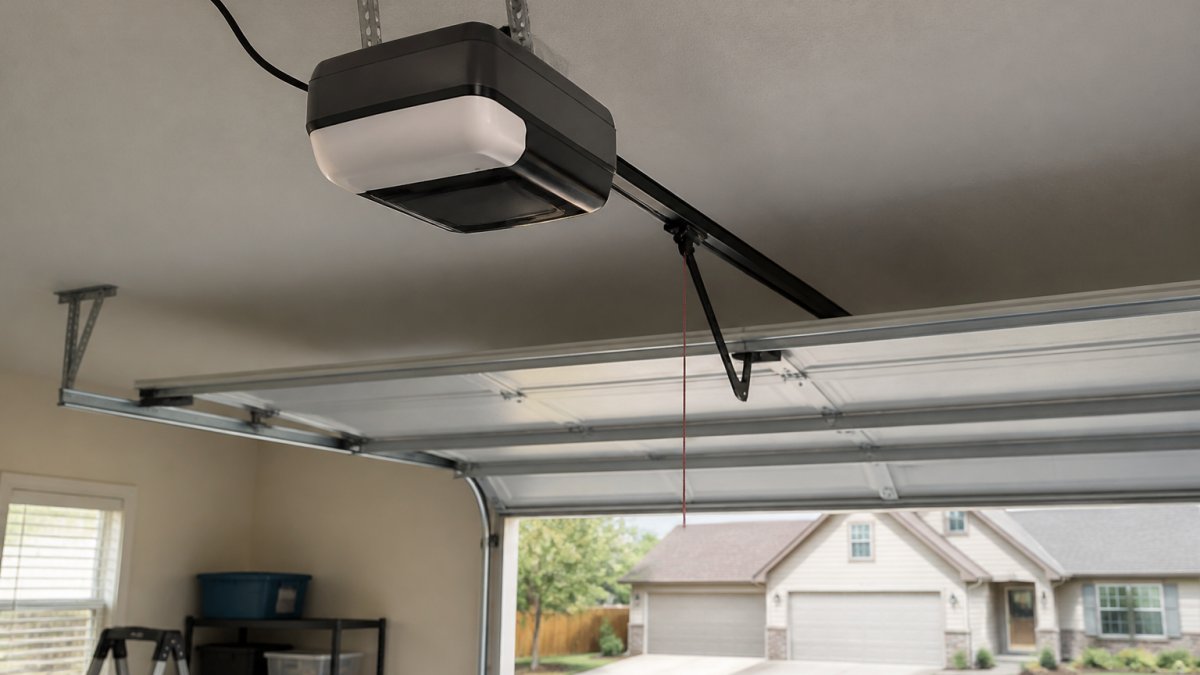
Trolley operators pull the door along a ceiling-mounted rail and remain the default for standard lift doors under moderate traffic. They handle door weights that jackshaft units struggle with and install on almost any ceiling structure.
Pros and Cons
Pros
- Handles heavier doors than side-mounted units
- Simple mechanical design, easy to service
- Works with most standard-lift configurations
Cons
- Requires ceiling clearance
- Not suited to continuous high-cycle operation
Check your door's actual weight against the operator's lifting capacity before ordering. A common mistake is sizing by door width instead of weight, which leads to a burned-out motor within the first year.
2. Jackshaft Operators: Best for High-Cycle Loading Dock Doors
Jackshaft operators mount beside the door on the torsion shaft, so they free up ceiling space entirely. That side-mount design makes them the go-to choice for loading dock doors running frequent cycles.
Pros and Cons
Pros
- No ceiling clearance needed
- Excellent for high-cycle dock doors
- Direct torsion shaft drive
Cons
- Higher upfront cost
- Requires wall space beside the door
3. Hoist Operators: Best for Oversized Industrial Doors
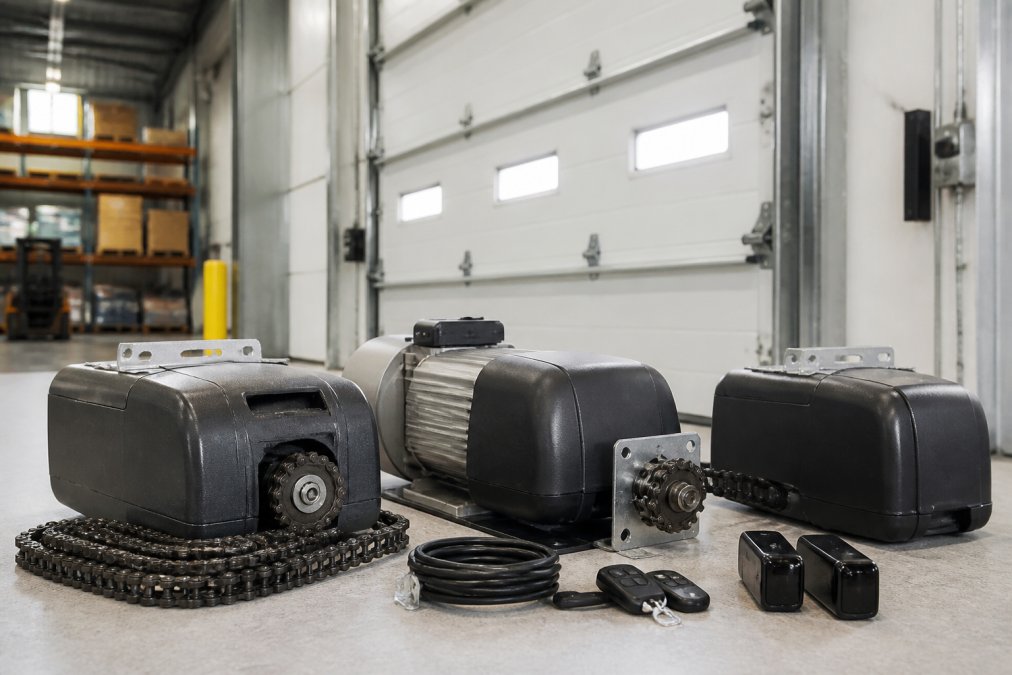
Hoist operators use a chain hoist mechanism to raise doors too large or heavy for standard operators. These are the units you specify for oversized industrial doors, where door weight and lifting capacity demand mechanical advantage.
Pros and Cons
Pros
- Handles the heaviest, largest doors
- Emergency manual release standard
- Built for industrial-duty cycles
Cons
- Slower cycle times
- More complex installation
4. High-Speed DC Operators: Best for Maximum Throughput
High-speed DC operators open and close doors in a fraction of the time standard AC units take, which directly increases dock throughput. In a busy warehouse, shaving seconds off every cycle adds up across a shift.
Pros and Cons
Pros
- Fastest cycle times
- High torque from DC motor
- Boosts operational efficiency
Cons
- Highest upfront cost
- Needs regular preventative maintenance
5. Smart-Connected Operators: Best for Remote Monitoring
Smart-connected operators add remote monitoring and access control, letting facility management track door status, cycle counts, and faults from a dashboard. For multi-site property managers, that visibility is the whole point.
Pros and Cons
Pros
- Remote monitoring and diagnostics
- Access control integration
- Feeds warehouse management systems
Cons
- Higher cost
- Connectivity doesn't improve duty cycle
Commercial Garage Door Opener Installation Cost: What Affects Your Quote
Installation cost depends on operator type, door weight, voltage and phase requirements, and whether your building needs electrical work. A jackshaft install on an existing three-phase circuit costs far less than a high-speed DC unit requiring new wiring and controls. But the quote is only the first line of the ledger. For a facility manager, the number that matters is total cost of ownership across the operator's service life.
Total Cost of Ownership: Beyond the Sticker Price
TCO for a commercial operator has four components, and most buyers only price the first:
- Acquisition and installation, the unit, the rail or shaft hardware, controls, and labor. This is the visible number.
- Preventative maintenance, scheduled lubrication, spring and cable inspection, sensor alignment, and control testing. High-cycle and high-speed units need more frequent service intervals than standard-duty units.
- Repair frequency and downtime, motors, gear reducers, brakes, and logic boards are the common failure points. A door stuck open is a security exposure; a door stuck closed is a shipping delay. Both carry a cost that never appears on the invoice.
- Energy consumption, the operator motor itself is a small load, but door open time drives the real energy cost by letting conditioned air escape.
Energy Efficiency and Insulation Impact
Opener selection affects HVAC load indirectly but measurably. Every second a dock door is open, heated or cooled air leaves the building. High-speed DC operators exist precisely because they cut open time, and pairing them with insulated doors and proper dock seals compounds the savings. The U.S. Department of Energy overview of commercial building energy use is worth reviewing if you are weighing insulated high-speed doors against standard units, since door open time is a direct input to heating and cooling load.
Compliance and Safety Checklist
Before signing off on any installation, confirm the following. This is the checklist that separates a compliant install from a liability:
- UL 325 entrapment protection, monitored photo eyes or constant-pressure control, with no bypassed or defeated safety devices.
- Manual release, a functioning means to operate the door by hand during a power loss.
- Warning signage and labels, required markings present and legible.
- Annual inspection, springs, cables, tracks, rollers, and operator controls checked on a documented schedule.
- Dock safety integration, vehicle restraints, dock levelers, and door controls coordinated so a door cannot cycle onto an occupied position.
Integration with Warehouse Management Systems
Modern operators increasingly expose door status, cycle counts, and fault codes over a network so that data can feed a warehouse management system or building automation platform. The practical benefit is predictive maintenance: a rising cycle count or a repeating fault code flags a unit before it fails. If your WMS tracks dock appointments, tying door events to that schedule turns the operator from a standalone machine into a data source.
Skipping UL 325 compliance checks on any operator voids your safety certification and exposes the facility to liability. Photo eyes and safety sensors are not optional on commercial installations.
Frequently Asked Questions
What is the best commercial-grade garage door opener for high-cycle use?
For high-cycle use, a jackshaft operator with a duty cycle rated for 25+ cycles per hour is the strongest choice. It mounts on the wall beside the door, leaving ceiling space clear, and handles torsion spring systems well. Match the opener's horsepower to your door weight and confirm the duty cycle rating before you buy. A unit rated below your actual daily cycle count will wear out faster and cost more in repairs over time.
How do I choose the right horsepower for a warehouse garage door opener?
Match horsepower to door weight and size. Light doors under 400 pounds often work with 1/2 HP, while heavier insulated doors or oversized openings may need 3/4 HP to 1 HP or more. Chain drive and belt drive options affect noise and maintenance, not lifting capacity. Always check the opener's rated lifting capacity against your door's actual weight, including any insulation or glass panels, before committing.
Are there specific safety standards for commercial garage door operators?
Yes. UL 325 is the primary safety standard for commercial garage door operators and covers entrapment protection, including safety sensors and photo eyes. OSHA also regulates workplace safety around powered doors in industrial settings. Any opener you install should carry UL 325 compliance, and your facility should have functioning photo eyes and emergency manual release on every powered door. Regular inspections keep you compliant.
How often should commercial garage door openers be inspected for safety?
Inspect commercial openers monthly for obvious wear and have a professional service them at least once a year, more often for high-cycle loading dock doors. Check safety sensors, photo eyes, torsion springs, and the emergency manual release during each inspection. A commercial garage door maintenance checklist helps you track these items and catch small issues before they become costly breakdowns or safety hazards.
Warehouse door failures rarely happen at a convenient time, and an operator that's undersized for its duty cycle will keep failing until it's replaced. American Eagle Garage Doors LLC handles both residential and commercial doors, specializing in opener repairs, spring replacements, and installation with competitive pricing and prompt, professional service. Get started with American Eagle Garage Doors LLC and request a free estimate for reliable, commercial-grade door operation.