 how-to
Garage Door Sales Near Me: How to Choose and Install
Table of Contents
- What You'll Need Before You Start Shopping for Garage Door Sales
- How to Measure for a New Garage Door
- Average Cost of Garage Door Installation and What Drives It
- Benefits of Insulated Garage Doors for Your Home
- Residential vs. Commercial Garage Door Sales: What's Different
- Step-by-Step Garage Door Installation Process
- Maintenance Checklist for Longevity After Your Purchase
- Frequently Asked Questions
Last Updated: September 12, 2026
What You'll Need Before You Start Shopping for Garage Door Sales
Garage door sales near me searches usually spike for one of two reasons: the door is broken, or the house is getting a facelift. Either way, walking into a purchase without measurements, a budget range, and a clear sense of what your existing opener can handle is how homeowners end up overpaying or buying a door that doesn't fit.
At American Eagle Garage Doors LLC, we've helped homeowners and property managers through both scenarios, and the pattern is consistent: the buyers who show up prepared get better outcomes and fewer surprises.
Here's what to gather before you request a single quote:
- Current door dimensions (width, height, and headroom above the door)
- Door type: sectional, tilt-up, or roll-up
- Opener details: brand, age, horsepower, and whether it has safety sensors
- Photos of the existing setup, including the tracks and springs
- Your budget range and whether installation is included in the quotes you're comparing
A torsion spring under tension stores enough energy to cause serious injury if handled without the right tools. That's why most manufacturers and safety bodies recommend leaving spring work to trained technicians, and why a "free estimate" from a qualified provider is worth more than a bargain quote from someone who won't show you their credentials.
How to Measure for a New Garage Door
The most accurate way to measure for a new garage door is to record the opening width and height at three points each, then note the headroom, backroom, and side room. Doors are built to the smallest measurement, so a single high spot can throw off the fit.
Measure the width at the top, middle, and bottom of the opening. Do the same for height on the left, center, and right. Write down the smallest number for each. Then measure:
- Headroom: distance from the top of the opening to the ceiling
- Backroom: how far back the door travels when open
- Side room: space on each side of the opening for the tracks
For a sectional door, you'll typically need at least 12 inches of headroom and 3 to 4 inches of side room on each side. Low-headroom setups call for a different track configuration, which is worth flagging to your installer up front.
If you're replacing a door, the old one already tells you most of this. But verify anyway. Framing shifts, and a door that "fit" ten years ago may not match the opening today.
U.S. Consumer Product Safety Commission guidance on garage door safety
Average Cost of Garage Door Installation and What Drives It
There's no single number for the average cost of garage door installation. Pricing depends on door size, material, insulation, hardware, opener compatibility, and whether the old door needs to be removed and hauled away. A basic single-car steel door and a custom carriage house style door for a three-car garage are not in the same pricing universe.
What actually moves the number:
- Material: steel is the most affordable; wood and aluminum with glass cost more
- Size: double doors and oversized openings require more material and labor
- Insulation: insulated doors cost more than non-insulated models
- Opener: a new opener, smart home integration, or remote access adds cost
- Labor: removal, disposal, and any framing or track adjustments
- Custom design: carriage house style, window inserts, and specialty finishes
Because pricing varies so much by configuration, the honest answer is that you need a written estimate based on your actual opening. American Eagle Garage Doors LLC provides free estimates, and that's the number worth comparing against other quotes.
DIY vs. Professional Installation: A Cost-Benefit Analysis
DIY installation looks cheaper on paper because you're not paying labor. In practice, the savings shrink fast once you account for the risks.
A garage door is the largest moving object in most homes. It weighs anywhere from 100 to 400 pounds depending on material and size, and it operates under spring tension. Torsion springs and extension springs store energy that can release violently if a cable slips or a winding bar fails. The Occupational Safety and Health Administration treats stored-energy hazards as a serious workplace risk for a reason.
Here's the honest breakdown:
| Factor | DIY | Professional |
|---|---|---|
| Upfront cost | Lower | Higher |
| Tools required | Winding bars, drills, ladders, safety gear | Included |
| Spring and cable work | High injury risk | Handled by trained technicians |
| Warranty coverage | Often voided | Typically preserved |
| Time to complete | A full weekend or more | Usually a single visit |
| Track alignment and tuning | Easy to get wrong | Dialed in on site |
The math only favors DIY if you already own the tools, have a second set of hands, and skip the spring work entirely. Most homeowners don't clear all three.
Benefits of Insulated Garage Doors for Your Home
An insulated garage door keeps the garage warmer in winter and cooler in summer, cuts noise from the street, and can improve the comfort of any room above or beside the garage. For attached garages, the door is often the largest uninsulated surface in the thermal envelope.
The benefits stack up quickly:
- Temperature control: less heat loss through the door in cold months
- Noise reduction: a quieter garage, especially for doors facing a street
- Durability: insulated panels are typically stiffer and resist dents better
- Curb appeal: insulated doors often come in more finish options
- Energy efficiency: less strain on HVAC systems in adjacent living space
If your garage shares a wall with a bedroom, kitchen, or living area, an insulated door is usually worth the upgrade. If it's a detached workshop you only use in summer, the case is weaker.
Understanding R-Value and Energy Efficiency Ratings
R-value is a measure of a material's resistance to heat flow. Higher R-values mean better insulation. Garage doors typically range from R-0 for uninsulated steel to R-18 or higher for premium insulated models.
What most buyers miss is that R-value isn't the whole story. Air leaks around the door edges, poor weather stripping, and gaps at the bottom seal can undo a high R-value entirely. A well-sealed R-9 door often outperforms a leaky R-16 door.
When you're comparing doors, look at three things together:
- The R-value of the door panel
- The quality of the weather stripping and bottom seal
- How well the door fits the opening
If you're not sure how your current door is performing, a technician can check the seals and track alignment during a routine visit.
Residential vs. Commercial Garage Door Sales: What's Different
Commercial garage door sales involve different products, different duty cycles, and different service expectations than residential work. A warehouse loading dock door that cycles 50 times a day needs heavier hardware than a home door that opens twice a day.
Key differences:
- Duty cycle: commercial doors are rated for high-cycle operation
- Size: commercial openings are often much larger
- Hardware: heavier springs, thicker cables, reinforced tracks
- Openers: commercial operators are built for continuous use
- Safety: additional safety features for high-traffic environments
- Service: downtime matters more, so response time is critical
For property managers overseeing multiple units, the practical takeaway is that a single provider who handles both residential and commercial doors saves you from juggling multiple contractors. American Eagle Garage Doors LLC works on both, which matters when you're managing a mixed portfolio.
Step-by-Step Garage Door Installation Process
A professional garage door installation follows a set sequence: remove the old door, prepare the opening, install the tracks and hardware, set the panels, install the springs, connect the opener, and test every safety feature. Skipping or rushing any step is how doors end up noisy, misaligned, or unsafe.
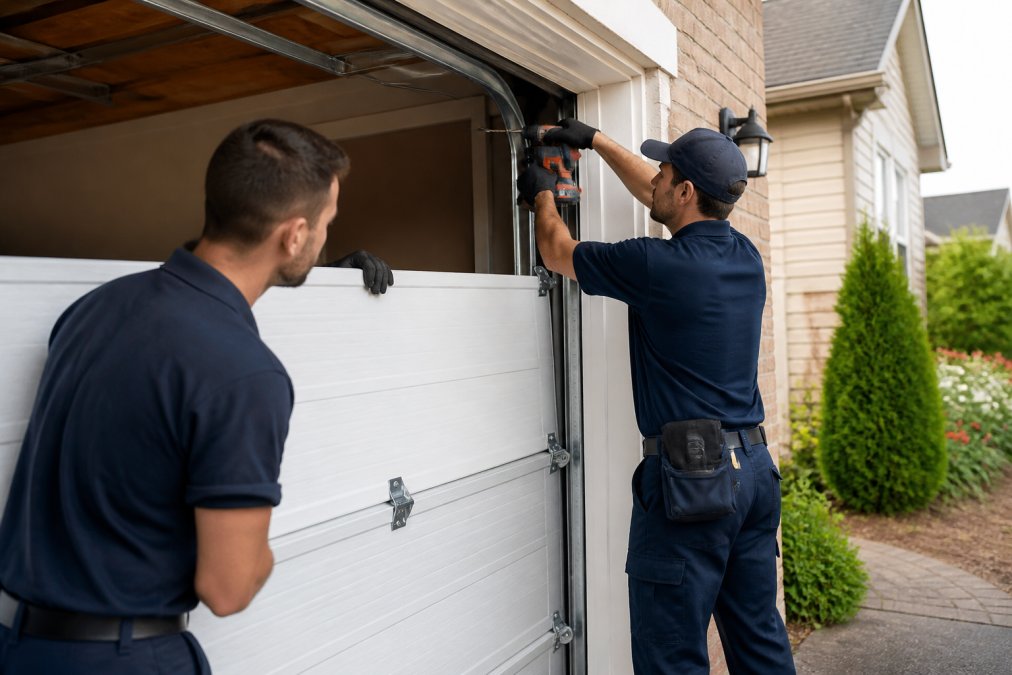
Here's the sequence a qualified installer follows:
- Remove the old door and opener. Disconnect power, release spring tension safely, and haul away the old hardware.
- Inspect and prepare the opening. Check the framing, header, and floor for level and square.
- Install the track and brackets. Align the vertical and horizontal tracks precisely; this sets the door's travel path.
- Set the panels. Stack the sections in order, checking alignment as you go.
- Install the torsion springs and cables. This is the highest-risk step and requires proper winding bars and technique.
- Attach the opener and hardware. Mount the opener, connect the arm, and set the travel limits.
- Test safety sensors and auto-reverse. Confirm the door reverses on obstruction and that sensors align.
- Lubricate and tune. Rollers, hinges, and springs get lubricated; the door gets balanced and run through several cycles.
Expected result: a door that opens smoothly, closes flush, reverses on contact, and runs quietly.
Common Mistakes to Avoid During Installation
The most common installation mistakes are misaligned tracks, over-tightened springs, and skipped safety sensor tests. Each one shortens the door's life and creates a safety hazard.
Watch for these:
- Track misalignment: causes binding, noise, and premature roller wear
- Improper spring tension: leads to an unbalanced door and opener strain
- Loose hardware: bolts and brackets work free over time if not torqued correctly
- Skipped sensor alignment: the door won't reverse properly, which is a serious safety issue
- Ignoring the bottom seal: gaps let in water, pests, and drafts
- Reusing old rollers and cables: cheap shortcut that fails within months
If your installer doesn't test the auto-reverse and safety sensors before leaving, that's a red flag. Ask them to walk you through it.
Maintenance Checklist for Longevity After Your Purchase
A new door will last 15 to 30 years with routine care. Without it, you'll be replacing rollers, cables, and springs far sooner than necessary.
Run through this checklist twice a year:
- Lubricate rollers, hinges, and springs with a garage-door-specific lubricant
- Inspect cables for fraying or rust
- Check spring balance by disconnecting the opener and lifting the door halfway
- Test the auto-reverse by placing a piece of wood in the door's path
- Verify safety sensors are aligned and the indicator lights are steady
- Tighten bolts and brackets on the tracks and hinges
- Check weather stripping and bottom seal for cracks or gaps
- Listen for new noises: grinding, popping, or squealing signal a problem
If the door feels heavy, jerks, or won't stay open at the halfway point, the springs need attention. Don't wait. A failing spring can snap and damage the door, the opener, or worse.
A garage door that won't open, won't close, or won't stay quiet is more than an inconvenience. It's a security gap, a safety risk, and a daily frustration. Whether you need a new installation, a spring replacement, or a commercial door serviced before it fails, American Eagle Garage Doors LLC brings prompt, professional service and competitive pricing to every job. Our team handles both residential garage doors and commercial garage doors, including spring replacements and opener repairs, backed by free estimates and a focus on getting it right the first time. Call American Eagle Garage Doors LLC today to schedule your free estimate and get your garage door working the way it should.
Frequently Asked Questions
What's the average price to install a garage door?
The average cost of garage door installation depends on door size, material, insulation, and whether you need opener replacement or track work. Steel doors cost less than wood or custom carriage house styles. Labor, disposal of the old door, and any structural changes add to the total. American Eagle Garage Doors LLC provides free estimates, so you get an exact quote for your Greeley or Evans home before any work begins.
How do I know if I need a new garage door or just a repair?
If your door has major panel damage, rust throughout, or repeated spring and cable failures, replacement usually costs less over time than ongoing repairs. A single broken torsion spring, noisy rollers, or misaligned track are repair jobs. A professional technician can inspect your door and tell you whether repair or replacement makes more sense for your budget and safety.
Are there specific safety standards for residential garage doors?
Yes. Residential garage doors sold in the U.S. must meet UL 325 safety standards, which cover entrapment protection and require safety sensors on automatic openers. Doors must also carry warning labels and be installed according to the manufacturer's instructions. A qualified installer verifies that your safety sensors, auto-reverse function, and hardware all meet current requirements before finishing the job.
Can you handle commercial garage doors for warehouse spaces?
Yes. Commercial garage doors for warehouses, loading docks, and facility buildings use heavier springs, high-cycle openers, and reinforced tracks compared to residential doors. American Eagle Garage Doors LLC services both residential and commercial properties in Greeley and Evans, including routine maintenance and emergency repair. Call to schedule a free estimate for your commercial property.